1. How Application and Absorption Work
Routes of Administration and Bioavailability
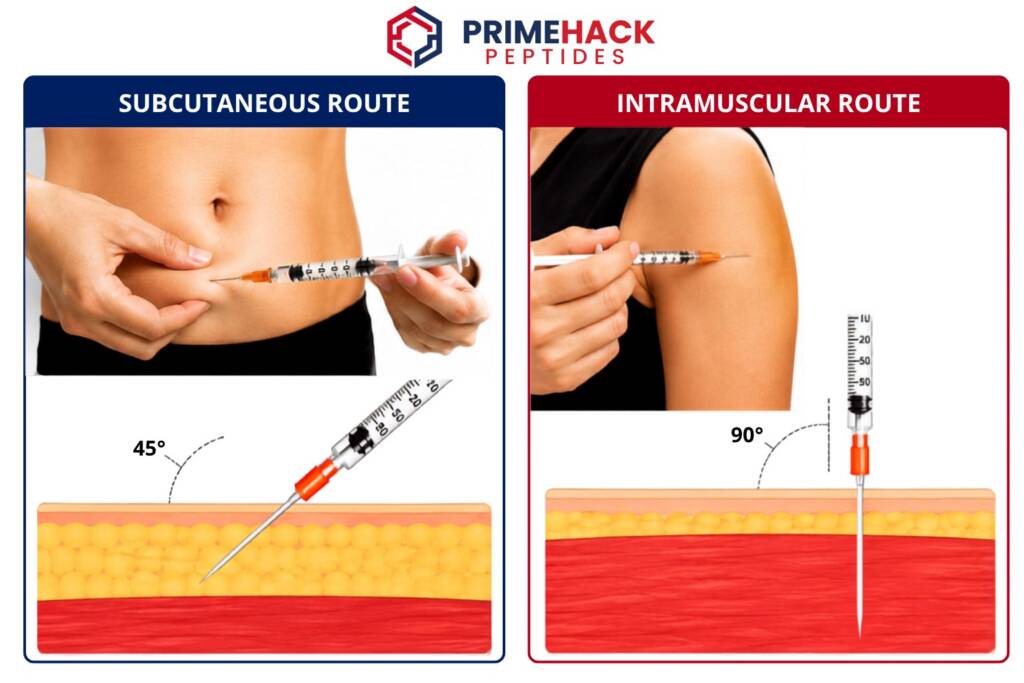
The application of PrimeHack’s advanced peptides is primarily conducted through two routes, depending on the molecular structure of each compound and the specific research objective:
Subcutaneous Route (Most Common): Administered directly into the adipose tissue just beneath the skin (typically in the abdominal area). This is the preferred method because fat tissue provides a slow, steady absorption rate, allowing amino acid chains to release gradually into the bloodstream without degradation.
Intramuscular Route: Administered directly into muscle tissue (such as the deltoids or quadriceps). This route is utilized for specific compounds requiring slightly faster onset or absorption due to the high blood flow within the muscle bed.
2. Introduction to the Proper Syringe (Precision Tool)
DOSING SYRINGE SPECIFICATIONS
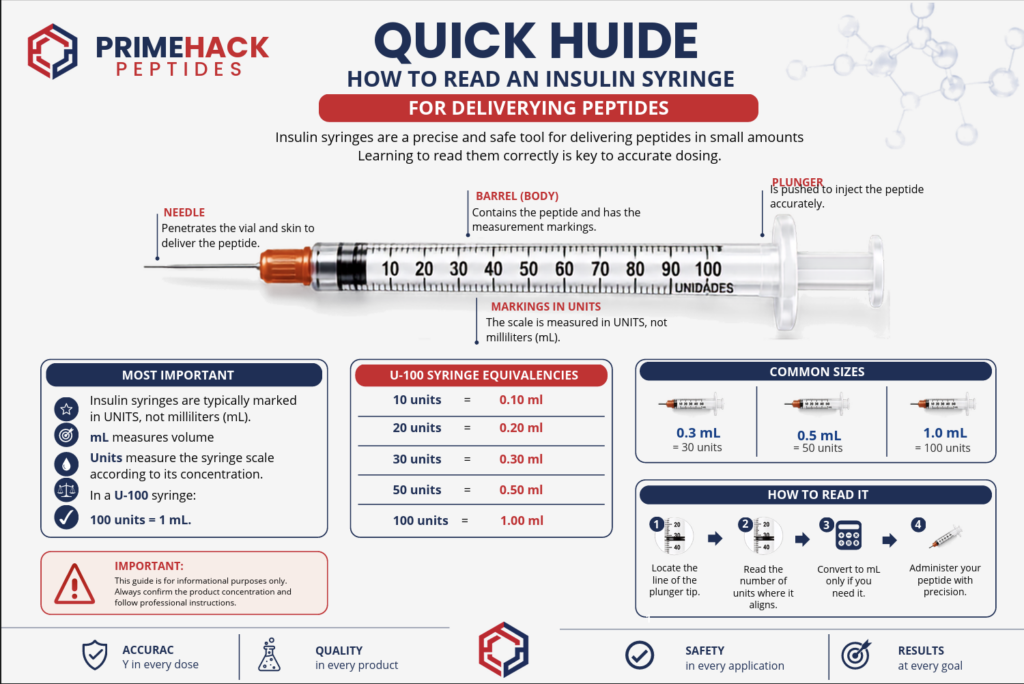
To handle and withdraw liquid from vials, conventional large-volume medical syringes cannot be used, as they compromise the exact accuracy required for microgram (mcg) dosing. The use of micrometric precision instruments is strictly required:
-
Structure and Calibration (U-100): Standard insulin syringes with a total volume capacity of 1 mL or 0.5 mL must be used, calibrated to the international U-100 scale (where 100 Units equal exactly 1 milliliter of liquid).
-
Needle Specifications: Integrated ultra-thin gauge needles are recommended, ideally 31G or 30G with a length of 5/16″ (8 mm). This microscopic gauge prevents damaging coring of the vial’s self-sealing rubber stopper, preserving the vacuum seal and preventing loss of active compound.
-
Unit Equivalences: Each graduation mark etched on the syringe barrel represents a unit of volume. This scale enables the researcher to calculate with mathematical precision how many units correspond to the exact target dose, based on the volume of bacteriostatic water used during initial reconstitution.
3. STORAGE AND STABILITY FACTORS
STORAGE AND RISK FACTORS
High-purity lyophilized peptides are fragile molecular structures that require controlled environmental conditions to maintain their biological potency and ensure an extended shelf life:
Thermal Fluctuations: Sudden temperature spikes break amino acid bonds, accelerating peptide degradation. Store reconstituted vials under constant refrigeration between 2°C and 8°C (36°F to 46°F). Avoid freezing the compound once reconstituted.
Mechanical Shock: Severe physical impact—such as dropping the vial or shaking it vigorously to dissolve the powder—causes cavitation and destroys the molecular chains. Always gently swirl or roll the vial between the palms of your hands.
Light Exposure: Ultraviolet radiation and direct light alter the chemical composition of the compound. It is recommended to keep vials stored in opaque packaging or wrapped in foil inside the refrigerator for complete isolation.